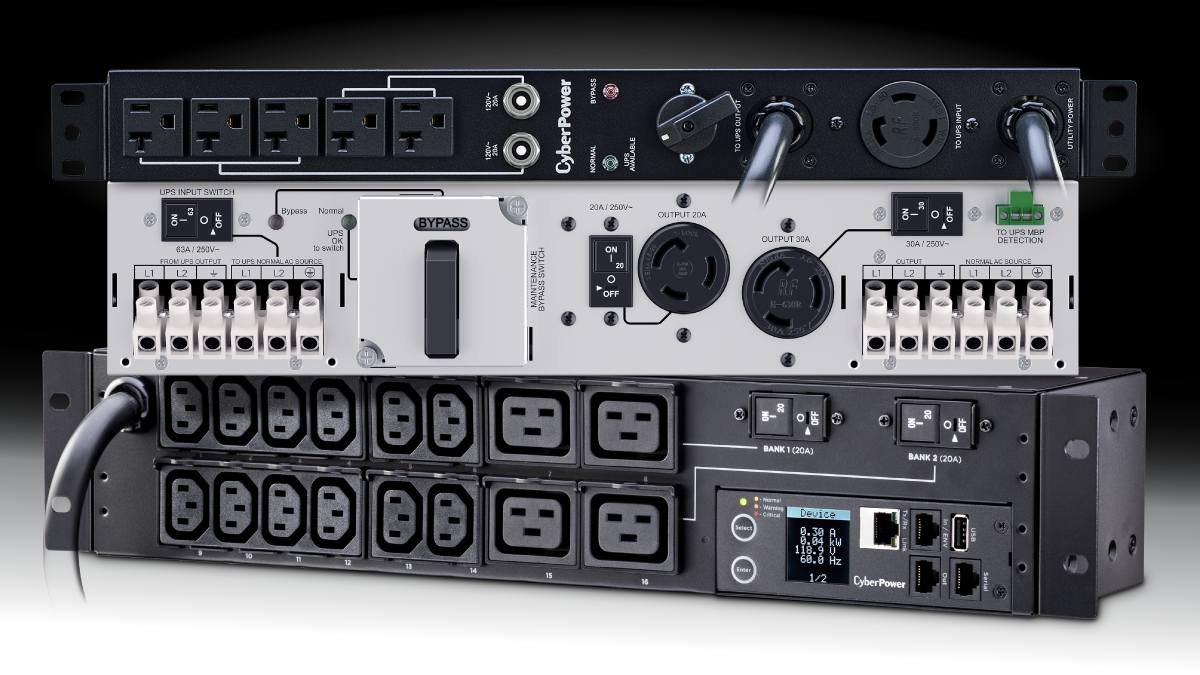
Your plug and receptacle primer
Did you know there are many different types of electrical plugs and outlets commonly used in North America? In this article, we’ll cut through the clutter to help you ensure you have the right plug and outlet to match your power protection and connected equipment.
When setting up an Uninterruptible Power Supply (UPS) system, Power Distribution Unit (PDU), or other equipment for your server room, office, or home lab, matching the right plug to your wall outlet is critical. Standard AC household plugs won’t always work for advanced power protection and other heavy-duty equipment. Before purchasing devices, always check your wall receptacles and circuit breakers. High-amperage equipment cannot be adapted down to a standard wall outlet without risking overloaded circuits, so ensuring a perfect match is the first step to reliable power protection.
Why are there different plugs?
Different plug types exist due to different electrical performance and safety standards for North America versus the rest of the world. The North American standard, NEMA (National Electrical Manufacturer’s Association) was designed for durability and versatility whereas the IEC (International Electrotechnical Commission) standard was aimed at standardization, compactness, and cost efficiency. For the purposes of this blog, we’ll focus on NEMA connectors.
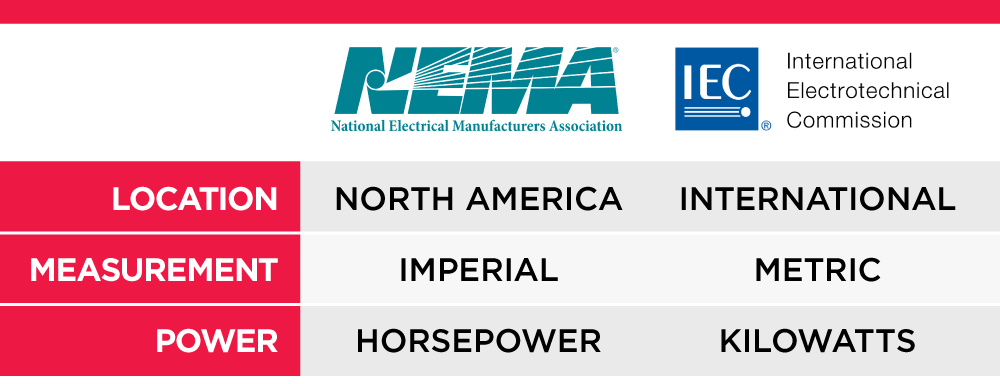
The standards developed for NEMA input (plugs) and output (receptacles) ensure you do not accidentally connect devices to power sources with incompatible voltages and amperages because it could create dangerous conditions. Most electronics rely on NEMA connectors, which fall into two primary categories: straight-blade and twist-locking.
Straight-Blade Plugs
These are the most familiar connectors, featuring flat, parallel blades.
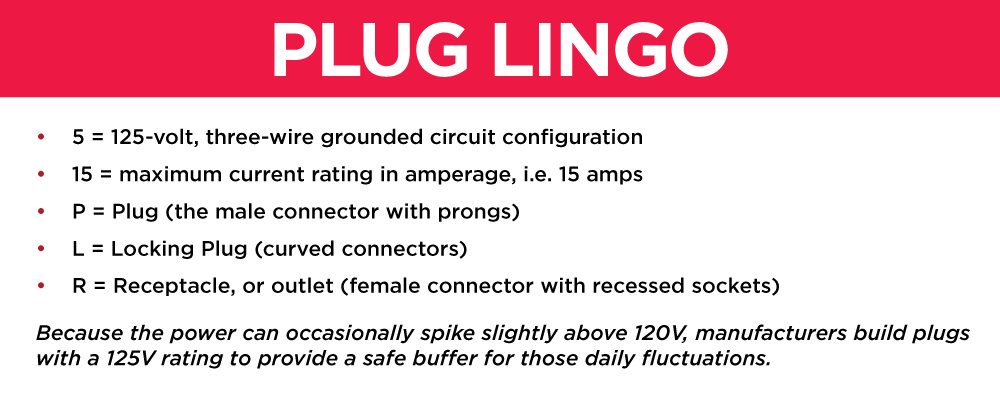
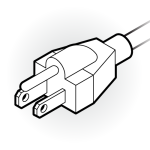
NEMA 5-15P:
NEMA 5-15R:
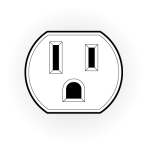
Description: The standard 15-amp consumer plug with two or three vertical prongs
Applications:
- UPS systems under 1500VA capacity
- AV equipment such as TV or speakers
- Home computers
- Household electronics and chargers
Compatible outlet: Any standard 120V wall outlet
NEMA 5-20P:
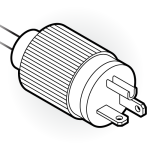
NEMA 5-20R:
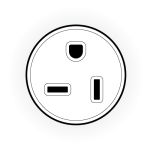
Description: Description: Only for 20-amp circuits, similar to the NEMA 5-15P but has one blade turned sideways
Applications:
- UPS systems with 2000VA capacity
- Network equipment
- Large power amplifiers
Compatible outlet: Compatible outlet: Only for 20-amp circuits
Twist-Lock Plugs
For high-capacity PDUs and UPS systems, secure power is paramount. Twist-lock plugs feature curved blades that lock into the receptacle with a turn, preventing accidental disconnections from cable strain or bumps. These plugs are typically identified with an “L”, indicating it’s a locking plug.
NEMA L5-20P & L5-30P:
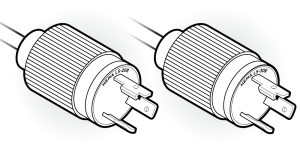
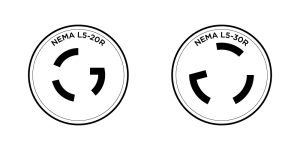
Description: Description: Standard voltage (120V) locking plugs rated for 20 or 30 amps
Applications:
- UPS systems with 3000VA capacity
- Large power amplifiers
Compatible outlet:Only for 20-amp or 30-amp circuits
NEMA L6-20P & L6-30P:
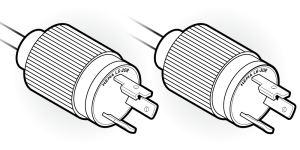
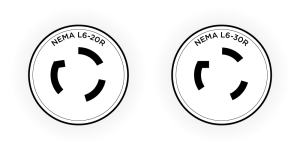
Description: Description: High voltage (208V/240V) locking plugs rated for 20 or 30 amps
Applications:
- UPS systems 3000VA capacity and higher
- Enterprise serverss
Compatible outlet: Only for 20-amp or 30-amp circuits
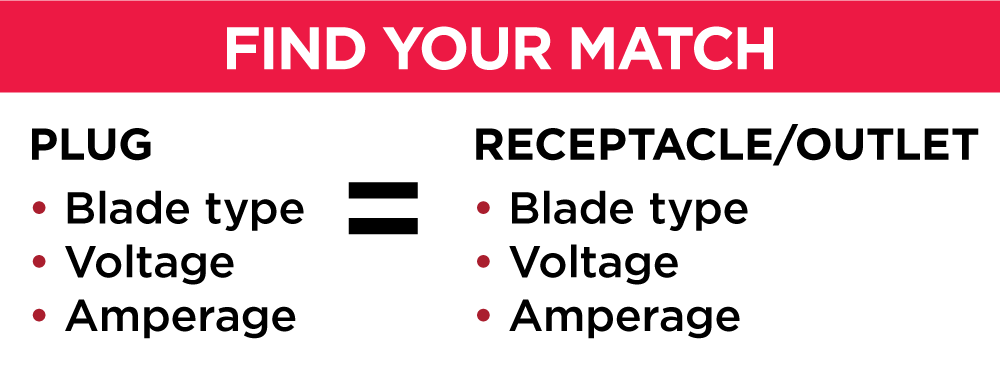
Find Your Match
Always match the correct plug with the correct receptacle. If they don’t match, it will be physically impossible to connect the plug to the receptacle, since both the IEC and NEMA standards ensure the plug blades are shaped and spaced differently.
Do’s and Don’ts

DO: Calculate Your Continuous Load Using the 80% rule, the National Electrical Code (NEC) mandates that a circuit should not be loaded past 80% of its maximum capacity for a continuous load, which is any electronic equipment that runs for three hours or more, such as a home lab.

DO: Consider a Dedicated Circuit: If you find your lights flickering when your audio amplifiers hit a bass note, or if your home lab trips the breaker when a server boots up, call an electrician to run a dedicated NEMA 5-20 or L6-30 circuit directly to your space.

DON’T: Consider a Dedicated Circuit: If you find your lights flickering when your audio amplifiers hit a bass note, or if your home lab trips the breaker when a server boots up, call an electrician to run a dedicated NEMA 5-20 or L6-30 circuit directly to your space.
A Plug for Our Free Power Assessment
Setting up a server room or looking to upgrade your power protection? Our complimentary Power Assessment starts by filling out a short form to collect some general information. A CyberPower sales associate will carefully review all the details and contact you in a day or two with a custom power recommendation from our engineering team.
Start your free power assessment.
From basic to advanced, CyberPower has a complete line of trusted power protection solutions to fit your specific needs. CyberPower is your ultimate ally in power.


